Christmas Faux Embroidery Patch Clipart
A Designer’s Real-World Review for Small Business Merchandise
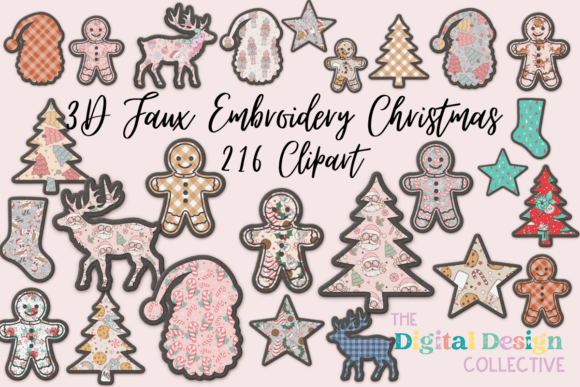
As an embroidery designer who’s digitized over 2,000 logos and patches for cafés, boutiques, bakeries, florists, and pet brands, I approach every new design asset with two questions: “Will it translate cleanly to thread?” and “Does it strengthen my client’s brand—not just decorate it?” When I first saw Christmas Faux Embroidery Patch Clipart, the title signaled something promising: a set built for visual authenticity *and* production readiness. The description—“216 PNG images” marketed for paper crafts and greeting cards—gave me pause. But don’t let the “clipart” label mislead you. This is a serious illustration pack with real potential for small business merch—if used intentionally.
First Impression: Handmade Charm Meets Commercial Flexibility
Right away, Christmas Faux Embroidery Patch Clipart feels friendly, nostalgic, and warmly handmade—not stiff or overly polished. The “faux embroidery” aesthetic suggests stitched texture, subtle shadowing, and soft edges—ideal for businesses wanting that artisanal touch without committing to full custom digitizing. It reads as classic yet modern, playful but not childish—perfect for a local bakery’s holiday aprons or a florist’s limited-edition tote bags. As an Illustrations product in the Graphics category, it leans into visual storytelling rather than technical precision. That’s both its strength and its limitation.
Where It Shines in Real Business Use
I tested several motifs from the pack across actual production scenarios—and here’s where Christmas Faux Embroidery Patch Clipart delivers:
- Embroidered patches: Clean outlines and moderate detail hold up well when converted to machine embroidery designs. Ideal for 2.5"–3.5" woven or chenille-style patches on staff uniforms or boutique merchandise.
- Apron embroidery & cap embroidery: Simpler motifs (like holly sprigs, minimalist stars, or stylized snowflakes) scale beautifully to chest pockets and front panels—even on curved cap surfaces, provided the design avoids fine interior lines.
- Tote bag design & product packaging accents: Larger elements pop on natural canvas or kraft paper labels. Their faux-stitched look adds tactile credibility to handmade product branding.
- Customer gifts & event merch: Because these are digital files, you can quickly create printable mockups for client approval—or layer them into custom apparel layouts for holiday markets.
- Etsy branding & craft business assets: The cohesive style across 216 PNGs makes it easy to maintain visual consistency across listings, social banners, and thank-you cards.
Where Caution Is Essential
This isn’t plug-and-stitch magic. As a professional embroiderer, I need to flag where Christmas Faux Embroidery Patch Clipart requires thoughtful adaptation:
- Small patch sizes (<2"): Fine details—like tiny stitching lines or narrow stems—will vanish or stitch poorly. Always simplify before digitizing.
- Cap fronts & curved surfaces: Avoid designs with rigid horizontal baselines or dense central clusters—they’ll pucker or distort without expert underlay and tension adjustment.
- Tiny lettering or intricate outlines: Since these are raster PNGs (not vector), scaling down risks pixelation. Never assume readability at 0.25" height.
- High stitch density areas: Some motifs simulate heavy fill stitches visually—but translating that to thread demands careful digitizing to avoid fabric puckering or thread breaks.
- Textured fabric & dark uniforms: The faux-shadow effect may get lost on tweed, corduroy, or black twill unless contrast is reinforced with thread color selection.
- Frequent washing: Remember—this is a *faux* embroidery aesthetic. For long-term durability on work shirts or aprons, pair it with high-quality stabilizer and dense, secure stitch types.
Brand Identity Impact: More Than Just Holiday Flair
Used strategically, Christmas Faux Embroidery Patch Clipart strengthens brand identity by reinforcing authenticity and care. A café using one of these motifs on barista aprons signals attention to detail—not just seasonal decoration. Customers subconsciously associate that handmade visual language with quality, warmth, and intentionality. That builds trust faster than generic snowmen or glitter fonts. It also supports visual consistency across touchpoints: same motif on a tote bag, a gift tag, and a staff cap tells a unified story. And for Etsy sellers or creative studios, it elevates perceived value—transforming “handmade” from a descriptor into a visible, repeatable signature.
Practical Embroidery Designer Notes
Before turning Christmas Faux Embroidery Patch Clipart into finished product, follow these non-negotiable steps:
- Test it in black and white first—value contrast matters more than color for stitch clarity.
- Check how it holds up at your smallest intended patch size (e.g., 1.75")—zoom in on edges and spacing.
- Review thread color contrast against your base fabric—especially on dark or textured materials.
- Inspect spacing between elements: tight gaps may merge in stitch; generous breathing room ensures legibility.
- Confirm hoop size compatibility—some motifs span wider than standard 4x4 hoops.
- Test on real fabric with your usual stabilizer stack—faux texture doesn’t guarantee real-world stability.
- Create a printable mockup for client approval before digitizing—avoid assumptions about scale or placement.
- Compare it beside your existing design assets—does it harmonize with your logo, typography, and brand palette?
- Verify commercial licensing—since this is marketed for paper crafts, confirm it permits use in embroidered patches, apparel, and resale merchandise.
Bottom line: Christmas Faux Embroidery Patch Clipart isn’t a shortcut—it’s a smart starting point. For small business owners, embroidery shops, and product designers, it offers speed, charm, and cohesion. But its true value emerges only when paired with professional digitizing judgment, fabric-aware execution, and brand-led intention. Use it thoughtfully, test rigorously, and let that handmade spirit elevate—not replace—your craftsmanship.