Santa Please Stop Here
A Designer’s First Look: Charm, Clarity, and Holiday Heart
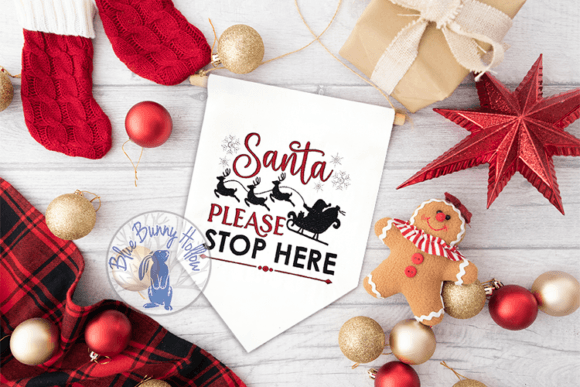
As an embroidery designer who’s stitched over 300 holiday collections for small shops and Etsy sellers, my first impression of Santa Please Stop Here was immediate warmth—like opening a well-wrapped gift with handwritten tags and cinnamon in the air. It’s not flashy or overly modern; it’s sweet, gently nostalgic, and unmistakably handmade in spirit. The lettering has soft curves and subtle flourishes—not too scripty to lose legibility, not too blocky to feel cold. There’s just enough detail in the “S” and “H” to suggest care without risking stitch distortion on delicate fabrics. It leans classic with a whisper of playfulness—exactly the kind of design that makes customers pause mid-scroll and think, “That’s the one I’ll give Grandma.”
Where This Design Truly Shines
Santa Please Stop Here is remarkably versatile across personalized gift categories—especially when authenticity and emotional resonance matter more than trend-chasing.
- Baby embroidery: Stitched on a muslin swaddle or organic cotton blanket, it reads as tender and timeless—not cutesy or cluttered. Perfect for nursery decor or newborn photo props.
- Wedding gift: Embroidered on linen pillow covers or monogrammed tea towels for the couple’s first Christmas together, it adds quiet, seasonal meaning without competing with formal aesthetics.
- Family keepsakes: On a quilt square, wooden ornament backing, or heirloom-style tote bag, it invites storytelling—“This is where Santa stopped for our first Christmas as a family.”
- Small shop product: For craft fairs or local gift boutiques, it pairs beautifully with natural textures—burlap sacks, oatmeal-colored towels, or unbleached canvas aprons—elevating simple items into intentional, giftable pieces.
- Etsy seller advantage: Its emotional clarity boosts click-throughs. Customers searching “personalized Christmas pillow cover” or “baby’s first holiday embroidery” instantly recognize its purpose—and its sincerity.
Smart Placement Matters—Know Your Limits
Like any thoughtful machine embroidery design, Santa Please Stop Here thrives when matched to the right substrate and application. Here’s where to proceed with gentle intention:
- Small lettering & fine details: Avoid shrinking it below 3.5 inches wide—especially for baby onesies or narrow towel hems. Tiny “i” dots or thin serifs may vanish or feather on low-stitch-density settings.
- Textured fabric: On heavy terry cloth towels or bouclé throws, use cutaway + tear-away stabilizer combo and reduce top tension slightly. Test first—the charm lives in crisp edges, not blurred outlines.
- Stretchy or unstable fabrics: Skip direct stitching on ribbed knit baby blankets or jersey totes unless fused with firm, wash-away stabilizer. Better to embroider on a stable patch, then appliqué.
- Curved surfaces: Not ideal for mugs or rounded ornaments—but excellent on flat pillow covers, tote bases, or folded blanket corners.
- Dark fabric: Works beautifully—but confirm thread color contrast in your digital embroidery file preview. A warm cream or antique gold often reads richer than stark white on navy or charcoal.
- Frequent washing: For embroidered towels or kitchen linens, choose high-quality polyester threads and lock stitches at start/end. Remind customers to turn inside-out before laundering.
Why This Design Builds Trust—and Sales
In a crowded marketplace, Santa Please Stop Here quietly signals craftsmanship and care. Its balanced proportions and clean spacing tell buyers: *This wasn’t rushed. This was chosen.* That perception lifts perceived value—even on modestly priced items like tea towels or cotton totes. When photographed beside pine sprigs and vintage books (no stock backgrounds needed), it invites emotional connection: nostalgia, anticipation, belonging. For Etsy sellers, that translates to longer dwell time, saved listings, and repeat customers asking, *“Do you have this in ‘Baby’s First Christmas’?”*
It also simplifies custom order previews. A printable mockup with Santa Please Stop Here on a neutral pillow cover or blanket sample gives clients confidence before committing—reducing back-and-forth and returns. And because it avoids dated slang or pop-culture references, it stays relevant season after season, supporting evergreen inventory for small shops.
Practical Embroidery Notes Every Maker Should Check
Before stitching your first customer order—or listing your first Etsy variation—run these checks:
- Test on scrap fabric that matches your intended product (e.g., terry cloth for towels, brushed cotton for baby blankets).
- Verify thread color contrast on both light and dark fabric swatches—what looks perfect on screen may mute on deep green linen.
- Confirm hoop size compatibility. Does it fit comfortably within your most-used hoops? If it requires re-hooping, factor in alignment time.
- Review stitch density. Overly dense fills can cause puckering on lightweight fabrics; sparse outlines may lack presence on thick weaves.
- Use proper stabilizer. Lightweight cutaway for knits, medium-weight tear-away for stable wovens, and fusible + wash-away for sheer or textured surfaces.
- Compare light/dark fabric mockups side-by-side before finalizing your product photos.
- Check small details post-stitch. Are the “t” crossbars clear? Do inner curves hold shape? Trim loose threads carefully—especially near letter junctions.
- Confirm commercial licensing before selling finished products. If your digital embroidery file came bundled with “Making Spirits Bright,” review terms carefully—some holiday bundles limit usage to personal or boutique-scale production.
The Final Stitch
Santa Please Stop Here isn’t just another Christmas embroidery—it’s a quiet invitation to slow down, personalize meaningfully, and deliver joy that feels earned, not expected. Whether you’re stitching baby embroidery for a first holiday, curating wedding gifts with intention, or building a trusted Etsy shop around handmade quality, this design supports your voice instead of overshadowing it. It leaves room for your craftsmanship to shine—and for your customers to feel seen. That’s the kind of holiday magic that sells year after year.