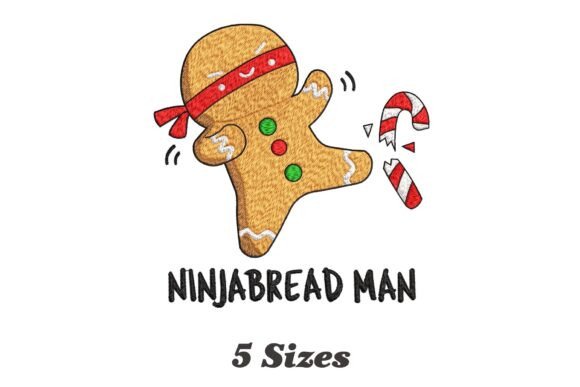
Ninjabread Man
First Impression: Playful, Festive, and Instantly Memorable
As an embroidery designer who’s prepped over 200 craft fair booths, I can tell you—Ninjabread Man lands with a grin. It’s not elegant or minimalist. It’s not rustic or farmhouse. It’s funny, modern, and unapologetically festive. The name alone triggers recognition and delight—especially in December—but its charm isn’t locked to Christmas. It reads as clever, slightly irreverent, and deeply handmade. That’s gold for craft fairs, where shoppers scan tables in under three seconds and buy with emotion.
Where Ninjabread Man Shines on Craft Fair Products
This machine embroidery design thrives where personality meets practicality. Here’s how it performs across real-world items I’ll stock at my next booth:
- Tote bag design: Perfect as a centered chest logo (4–5” wide). Stands out against natural canvas or black denim—no competing patterns needed.
- Apron embroidery: Ideal on the lower left corner or pocket flap. Adds levity to kitchen-focused vendors without undermining utility.
- Tea towel embroidery: Works best on flour-sack cotton—not terry cloth. Keep it above the hemline so it’s visible when draped over a counter or oven handle.
- Embroidered patch: A top-tier option. Heat-seal or sew-on versions sell fast as impulse gifts. Pair with mini iron-on instructions for DIY buyers.
- Fabric pouch & pillow cover: Excellent as a single focal motif. Avoid centering on seams; offset slightly for visual balance and stitching ease.
- Caps & market bags: Use only on structured, medium-weight caps (not curved low-profiles). On reusable market bags, place it just below the handle seam—where eyes naturally land.
What Makes Ninjabread Man Sell—Beyond Cuteness
It’s not just charming—it’s strategically legible. At 3–4”, the ninja silhouette, gingerbread texture cues, and expressive face hold clarity. That means it photographs well for Etsy listings and printable mockups. Buyers scrolling on mobile instantly “get it.” No decoding required. And because it’s not overly detailed, it’s highly repeatable for batch production—critical when embroidering 30+ tea towels overnight before a Saturday fair.
It also lifts perceived value. A plain cotton tote becomes a handmade product with personality the moment Ninjabread Man appears. That subtle shift lets you price 20–30% higher than generic alternatives—without feeling inflated.
Careful-Use Notes Every Embroidery Designer Should Check
Don’t assume this design is foolproof. As a working designer, I test every file before cutting fabric. With Ninjabread Man, watch for:
- Dense stitch areas: Ninja belts or cookie cracks may run heavy. Confirm stitch density isn’t overwhelming thin fabrics like chambray or lightweight linen.
- Tiny details: Eyes or weapon accents could blur on textured towels or dark fabric. Always test thread contrast—navy thread on black terry? Skip it. Opt for metallic silver or bright white instead.
- Curved surfaces: Caps and pouches need careful hooping. If the design wraps too tightly around a curve, features distort. Stick to flat or gently rounded zones.
- Small sizing: Below 2.5”, facial expression and ninja stance lose definition. Avoid using it as a tiny accent on cuff or hem—it won’t read.
How Ninjabread Man Strengthens Your Booth & Brand
In person, Ninjabread Man creates instant buyer engagement. Kids point. Adults smile and say, “Oh—I *need* that.” That micro-moment opens conversation, builds rapport, and makes your table feel warm and human—not transactional. It also supports brand consistency: if your shop leans playful, quirky, or holiday-forward, this design reinforces your voice across tote bags, patches, and aprons.
For Etsy sellers and small shop owners, it’s versatile digital embroidery file equity. Use one version for physical products, another cropped for social banners, and a simplified line-art variant for printable mockups. That’s efficient design asset reuse—no extra fees, no redraws.
Practical Embroidery Designer Notes Before You Stitch
Before cutting into your best fabric or loading 50 hoops:
- Test the embroidery file on scrap fabric matching your final product—same weight, same texture, same dye lot.
- Check thread colors against your base fabric. Contrast is non-negotiable for visibility.
- Review spacing between elements—does the ninja’s arm clear the cookie edge cleanly? Tight gaps snag or skip.
- Confirm hoop size compatibility. If your machine requires rehooping mid-design, factor in time—and potential alignment drift.
- Inspect stitch density. High-density fills heat up stabilizer; use tear-away + light cut-away combo for towels or bags.
- Create at least one real mockup—not just digital. See how light hits the stitches in daylight vs. booth lighting.
- Compare fabric colors side-by-side: cream vs. oat vs. charcoal all change how the ninja “reads.”
- Verify commercial licensing status. This is a commercial embroidery product—you must confirm you’re cleared to sell finished goods.
Final Thought: Ninjabread Man Is Booth-Ready Charm
Ninjabread Man isn’t just another Christmas-themed embroidery file. It’s a conversation starter, a repeatable seller, and a smart bridge between handmade authenticity and joyful commercial appeal. It works because it feels intentional—not trendy, not forced, but genuinely fun to make and even more fun to own. For craft fair sellers, Etsy sellers, and boutique makers building a cohesive, scalable line of small shop products, this is the kind of design that earns smiles, shares, and steady reorders. Just remember: test, tweak, and trust your eye—then let the ninja do the rest.