Angel Child: A Thoughtful Holiday Embroidery Design
First Impressions: Charm That Feels Intentional, Not Cliché
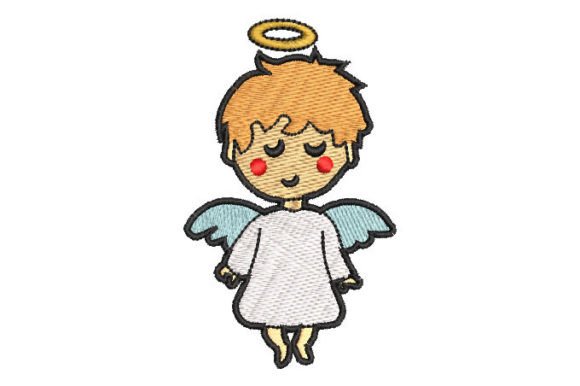
When I opened Angel Child for the first time, I didn’t see another generic holiday silhouette—I saw quiet storytelling. The pose is gentle: arms slightly raised, wings softly curved, head tilted just enough to suggest innocence without saccharine sweetness. It’s not overly detailed, but it’s not minimalist either—there’s careful balance in the satin-stitched halo, the subtle fill-stitch texture of the robe, and the clean running-stitch outline that holds everything together. This isn’t a design shouting “Christmas!”; it whispers “tenderness,” “care,” and “handmade warmth.” That nuance matters—especially when you’re stitching for real people who’ll hold, wear, or gift the finished product.
A Real-World Test: Stitching Angel Child on a Linen Tea Towel
Last week, I used Angel Child on a natural linen tea towel for a small-batch holiday collection. Why that combo? Linen has texture, minimal stretch, and breathability—ideal for testing how well the design handles fabric grain and stitch definition. I chose medium-weight cutaway stabilizer (not tear-away) because the wings and robe edges needed crispness, not flutter. With standard 40-weight polyester thread in soft ivory and pale gold, the design stitched cleanly at mid-range speed—no skipped stitches, no thread breaks, no puckering. The result? A piece that looked intentional, not machine-made: the satin stitch halo caught light gently, the fill stitch in the robe held body without stiffness, and the overall scale felt generous but not overwhelming on a 12” x 18” towel.
Where Angel Child Shines—and Where It Asks for Attention
Angel Child works beautifully on stable, medium-weight fabrics: cotton canvas for tote bags, fleece-lined sweatshirts, quilting cotton for baby blankets, and twill for embroidered patches. On a custom apron for a local bakery’s holiday staff gift? Perfect—the wings framed the chest pocket elegantly. On a newborn onesie? I scaled it down to 3.2”, used lightweight tear-away stabilizer, and swapped to 60-weight thread for delicacy. Customers responded immediately—not just to the image, but to how *considered* it felt.
But be mindful: avoid Angel Child on highly textured knits (like bouclé sweatshirts) without extra stabilizing—it can blur detail in the wing feathers. Skip it on ultra-thin rayon or silk unless you’re using water-soluble topping and fine needles. And while it reads clearly on dark fabric with high-contrast thread, test the halo’s satin stitch on black terry cloth first—dense satin over pile can flatten or snag. Also, don’t force it into a 3” hoop for caps: the wings extend beyond safe margins on curved surfaces. Stick to flat or gently contoured items like pillow covers, kitchen towels, or front-of-tote placements.
What This Design Does for Your Craft Business
As an Etsy seller and small shop owner myself, I judge embroidery files not just by stitch count—but by how they elevate perceived value. Angel Child does that quietly. It reads as “designed,” not “downloaded.” When customers see it on a handmade baby blanket or personalized holiday ornament, they sense care—not just decoration. That builds trust. It also supports brand consistency: whether you’re selling nursery decor, boutique apparel, or craft fair merchandise, Angel Child fits a cohesive, warm aesthetic without locking you into kitsch.
For digital product sellers, this is strong design assets material. Pair it with a simple “Joy” or “Peace” monogram in your mockup library—it layers beautifully in printable mockups for social posts or listing thumbnails. And yes, it works for commercial embroidery: the clean lines and balanced stitch density mean fewer re-runs on production runs, less thread waste, and smoother transitions between garments.
Designer Notes You’ll Actually Use
- Always test on scrap fabric first—especially if you’re using it on a new substrate like brushed poly or organic cotton jersey.
- Check thread color contrast early. Ivory-on-cream reads softly; navy-on-charcoal may mute the halo. Try black-and-white mockups to assess silhouette clarity.
- Review stitch density visually, not just in software. Dense fill areas (like the robe base) should breathe—don’t let them overwhelm lighter sections (wings, face outline).
- Confirm hoop size compatibility before prepping a batch. If your smallest hoop is 4” x 4”, verify the full design fits comfortably within that space—including jump stitches and tie-offs.
- Inspect small details at 200% zoom: Are wing tips sharp? Is the halo fully closed? Does the face outline stay legible at 3.5”?
- Use proper stabilizer for your fabric type—cutaway for knits, tear-away for stable wovens, and water-soluble for sheer layers.
- Confirm licensing terms before selling finished items or bundling Angel Child into digital embroidery collections. Some licenses allow personal use only; others permit commercial embroidery or resale of physical products. Don’t assume.
Final Thought: It’s Not Just a Christmas Design—It’s a Feeling You Can Stitch
Angel Child doesn’t try to be everything. It doesn’t shout. It doesn’t overload. It simply offers presence—a quiet, graceful figure that lands with sincerity on baby onesies, kitchen linens, boutique apparel, and heartfelt holiday gifts. For designers, crafters, and creative entrepreneurs, that kind of restraint is rare—and valuable. It gives you room to build around it: pair it with hand-lettered tags, coordinate it with seasonal packaging, or feature it as the centerpiece of a limited holiday collection. When your customers run their fingers over the satin halo and feel the gentle texture of the fill stitch, they’re not just holding embroidery—they’re holding intention. And that’s what makes Angel Child more than a machine embroidery design. It’s a thoughtful tool for meaningful making.